Network Extender, free & self-serve.
Turning a hidden hardware benefit into a proactive retention tool for customers with poor home signal
PROBLEM
CONTEXT
Verizon already had the solution to poor home signal: a free Network Extender device eligible customers could receive at no cost. The problem wasn't the product — it was the path to it. The only way to get one was to call customer care, navigate a manual triage process, and wait up to 7–8 business days for resolution.
For customers already frustrated by weak signal, that barrier was often the last straw.
This project replaced that friction-filled journey with a fully digital, self-serve flow — one that could proactively reach customers before they gave up and churned.
My Role: Lead Experience Designer — Strategy, Interaction Design, Omnichannel Implementation, cross-functional collaboration with Network Operations, Engineering, and Support.
SYSTEM MAP
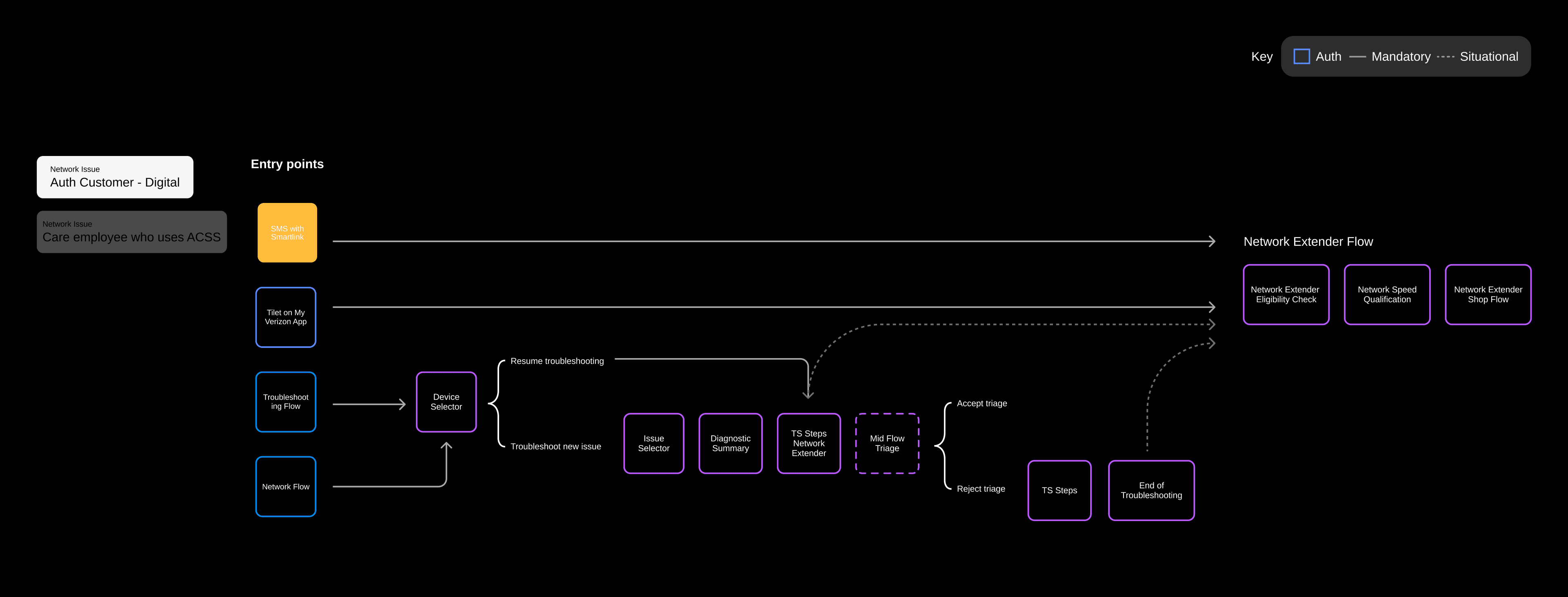
We mapped multiple entry points across Verizon's digital and assisted ecosystem — ensuring the Network Extender offer could surface wherever a customer was most likely to need it. This wasn't a single page redesign; it was a connected system of moments, each capable of routing an eligible customer to the same streamlined fulfillment flow.
FINAL EXPERIENCE
Four screens, zero calls, free device at the end.
The flow begins with a proactive Smartlink sent to eligible customers. It opens with a plain-language signal check — asking one honest question to confirm eligibility. If they qualify, they're taken directly into the order flow: confirm address, review the $0 order, done.
Every decision in the design prioritized transparency and forward momentum:
Plain language throughout — no technical jargon, no Verizon-internal terminology
An honest "what happens next" — customers always knew where they were in the process
A graceful exit for non-qualifying customers — no dead ends, no abandoned states

"Our goal was to move from support being a friction point to support being a retention strategy. The Network Extender isn't just hardware — it's a commitment to the customer's connectivity."